As discussed in my previous article, I suggested that emerging growth companies need to focus on how they create value and then how much of that value they capture.
Let’s look at this from another angle…by taking a detour to talk about the cost of health care.
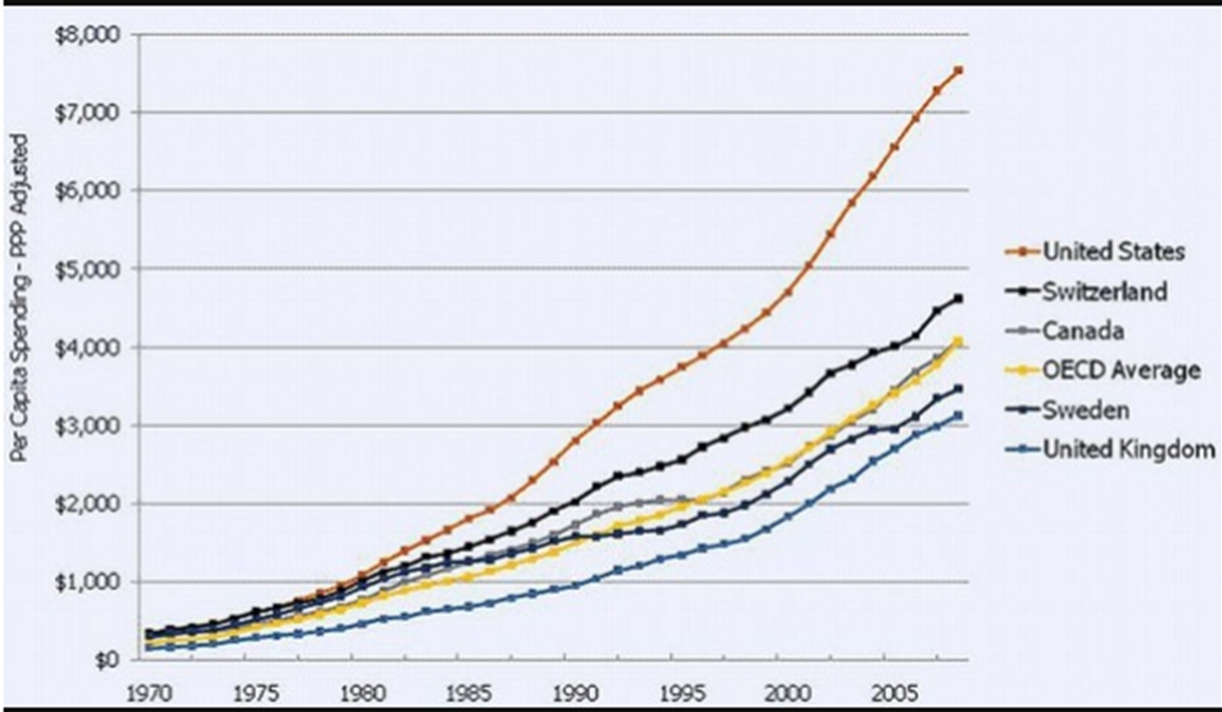
Americans are really upset about the cost of health care. The table below shows the increase in healthcare costs from 1970 to 2007 in the United States as compared to a few developed countries. In the 1970s, the United States looked a lot like other countries. In 1980, we spent $1,110 per person on health care, which was 9.2 percent of GDP. In the 1980s, health-care costs in the United States began growing much faster than in other countries, rising to $8,402 per person in 2010. That’s a total of $2.54 billion or 17.9% of GDP spent on health care. We blame lots of institutions, companies, and individuals for this current state of affairs, and the pharmaceutical companies receive a special share of our invective.
I take no sides in this debate. We really do value, however, what the pharmaceutical companies produce. In 2011, we were willing to pay Johnson & Johnson more than twice the cost of the ingredients it took to produce its products and almost 25% more than all the costs it expended in producing, delivering, marketing, and selling its products. We paid Pfizer about three and one-half times the cost of the ingredients it took to produce its products and about 26% more than all the costs it expended in producing, delivering, marketing, and selling its products.
Take a look at the image below. You may recognize it. It’s Michael Porter’s “Five Factors of Industry Analysis.” I call it a “value grid,” and in terms of creating, delivering, and capturing value, I have seldom seen a more enviable position than the one enjoyed by the pharmaceutical companies.
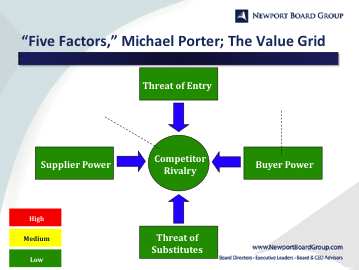
Think of the pharmaceutical companies as occupying the circle in the middle. In 2008 the 49 largest pharmaceutical and biotech companies in the world had a little over $640 billion in healthcare revenue of which the top 11 enjoyed almost two-thirds of that revenue. Moreover, they had the knack of staying out of each others’ way in terms of pricing. Consequently, competitive rivalry is not all that intense.
J&J and Pfizer spent 11.5% ($7.5 billion) and 13.5% ($9.1 billion) of sales, respectively, on research and development in 2011. So how easy do you think it will be for someone from outside the industry to knock them from their perch? Not very likely?
All of us buy their products because we really need them. The only way we would give them up is if we couldn’t afford them. That’s more than 314 million men, women, and children as I write this piece. So we have a highly fragmented purchasing constituency with a need to consume their products for our well-being. Consequently, the buying power of any one of us, or even of an influential group of us, is something close to nil.
We’ve already determined that ingredients costs make up a small portion of J&J’s and Pfizer’s total cost structure. The ingredients in their products amount to only 31% and 22% of revenue, respectively. So, none of their suppliers have sufficient leverage to extract significant value from them.
It’s highly unlikely that anyone, other than Big Pharma itself, will develop a substitute. It’s not as if we haven’t tried. Think of herbal concoctions, acupuncture, and other “alternative” cures.
I would suggest to emerging growth business owners that they construct a “value grid” for their own businesses, asking themselves who in their own “value system” is capturing value? If you are creating and delivering value, but you are not capturing value, there is a structural problem in your industry. You need to solve that problem, or you will struggle mightily to get out of No Man’s Land.