

Introduction
You’re an avid LinkedIn participant, and you keep your oar in the water when it comes to career management. You’ve just noticed a job posting, and it sounds rather intriguing. It’s for a CEO opportunity, and it has the usual leadership verbiage: “The successful candidate will be an accomplished leader with knowledge and experience spanning all aspects …….yada, yada, yada, and more yada. What really caught your eye, however, were the following bullet points:
Challenges:
-
Balance sheet restructuring of monumental proportions;
-
Extrication from costly foreign investment in global tinder box with minimal repercussions;
-
Substantive increase in revenue stream amid need for drastic cost reduction
Responsibility:
-
First, for the health and well-being of everyone in the United States;
-
Second, for the health and well-being of everyone on earth.
Benefits:
-
Stately mansion in the heart of Washington, DC;
-
Access to country retreat in low wooded hills of Frederick County, Maryland 60 miles northwest of Washington; transportation provided by luxurious helicopter;
-
Huge private aircraft with every conceivable amenity;
-
Bodyguards for life for your family and you;
-
Generous retirement compensation.
We thought it would be both fun and informative to take a look at the upcoming election in the context of operating a business and hiring a CEO. We have no interest whatsoever in influencing your vote, and we have done our absolute best to remain neutral. We believe we have accomplished that objective. We believe we have presented the facts with no prejudice toward one party or the other, one candidate or the other, or any particular position. We hope you enjoy our perspective and appreciate our presentation of the facts.
Chapter 1
This Time It Probably Is
We Americans have a gift for the superlative. Google “the game of the century.” Seriously, as the Nike folks say, “Just do it.” It’s truly remarkable, isn’t it? Google displays about 400 million results. The second item displayed is a Wikipedia page that contains twelve games considered “the game of the century.”
Now, Google “the most important election of our lifetime.” Google displays approximately 3.4 million results. Hmmmm, 3.4 million results for “most important election of our lifetime” and 400 million results for “game of the century.” Does that say something about how we Americans value elections versus sports? The dominant theme of the first page of the results is, “We say this every four years.” We’d like to make the case that this time it’s different. This time it probably is “the most important election of our lifetime.” Why? Because our country is in the worst economic crisis of our lifetime, due to a combination of The Great Recession and two wars. Take a look at the chart below.
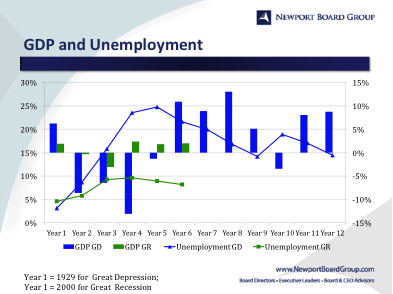
The Great Depression and Recession
The chart shows The Great Depression (GD) data in blue bars and line with Year 1 as 1929 and Year 12 as 1940. It shows Great Recession (GR) data in green bars and line with Year 1 as 2007 and Year 6 as 2012 (through July). The left axis measures unemployment during the years of the Great Depression (blue line) as compared to unemployment during the years of the Great Recession (green line). As you can see, unemployment during the Great Recession was not nearly as severe as during the Great Depression. At its height Great Recession unemployment reached 9.6% of the labor force in 2010 or 7.7 million jobs lost from the day the recession began. In contrast Great Depression unemployment reached 24.7% of the labor force in 1933 or 11.3 million jobs lost.
The axis on the right measures GDP growth during the Great Depression (blue bars) against GDP growth during the Great Recession (green bars). During the Great Recession, there were two years of negative growth with peak decline of 3.1% in 2009, while during the Great Depression there were five years of negative growth with peak decline in 1932 of 13.1%. The contraction in GDP during the Great Depression reached its crescendo at a decline of 26.7% in 1933, and it took seven years for the economy to work its way back to where it was at its start. Conversely, contraction during the Great Recession reached its zenith in 2009 at 3.4%, and it took four years for the economy to work its way back to where it was at its start.
Despite the fact The Great Recession was the worst economic decline most of us have known in our lifetimes, it was not nearly as cataclysmic as our parents and grandparents endured during the Great Depression. This story, however, is not yet over. The second chart paints a more disturbing picture.
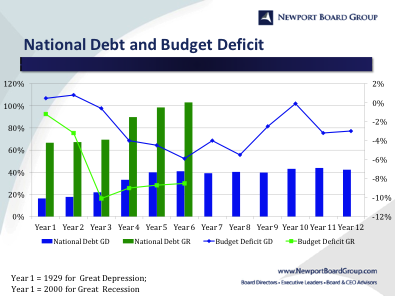
As can be seen on the right axis (blue and green lines), the budget deficits during the Great Depression, measured in terms of percent of GDP, weren’t nearly as deep as the budget deficits during the Great Recession. The deepest budget deficit during the Great Depression was 5.9% of GDP in 1934; the deepest budget deficit during the Great Recession was 10.1% in 2009.
The national debt on the left axis (blue and green bars), measured again in percent of GDP, did not get much above 40% during the Great Depression. Conversely, it has reached more than 100% of GDP in 2012, and it’s continuing to increase. There must be something else going on here…..and there is. The chart below tells us what that something else is.
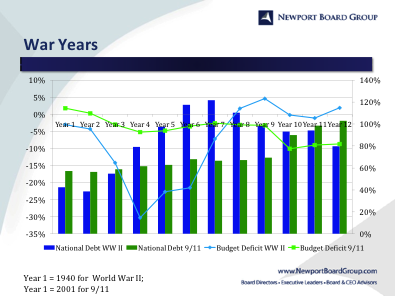
In this chart Year 1 is 1940 and Year 12 is 1951 for the war years associated with WWII, while Year 1 is 2001 and Year 12 is 2012 for the war years associated with the terrorist attacks of September 11, 2001. This chart compares budget deficits (blue and green lines) and national debt (blue and green bars) during and after WWII against the war years subsequent to the terrorist attacks on September 11, 2001. The chart says the deficits (left axis) during WWII (blue line) were deeper than the deficits of 9/11 (green line), and the national debt (right axis) during WWII (blue bars) was greater than during 9/11 (green bars). In fact both the budget deficit and the national debt during WWII reached record levels with the budget deficit peaking at 30.3% of GDP in 1943, and the national debt reaching its zenith of 121.7% of GDP in 1946.
However, and here’s the point, beginning in Year 8 (1947) of the WWII war years, the country began to experience budget surpluses, while in Year 8 (2008) of the 9/11 war years the country was on the verge of steeper budget deficits brought about by the Great Recession. In Year 8 of the WWII war years the national debt began to decline, while in Year 8 of the 9/11 war years, it was about to increase dramatically, again as a result of the Great Recession.
It’s very hard to dispute that the most cataclysmic events to befall our country during the 20th Century were the Great Depression and WWII. So is it possible that the Great Recession plus two wars is just about equal to The Great Depression plus WWII in terms of impact on the federal budget and national debt. The possibility that it may be is why this election probably is “the most important election of our lifetime.”


