

In Greek mythology Cassandra was the daughter of King Priam and Queen Hecuba and she had the gift of prophesy. When Cassandra rebuffed the god Apollo’s affections, he cursed his gift by causing Cassandra’s prophesies to be unheeded. So Cassandra was able to foretell the future, but she was fated never to be believed.
This phenomenon—companies refusing to take seriously competitive threats to its products--occurs in business every day. Here’s an example. In another life I was the CEO of a cheerleading company. At the time we were the second largest supplier of camps, competitions, and apparel to the cheerleading world. Our apparel included both practice wear and uniforms. Our highest volume, most expensive, and best margined uniform item was a pleated skirt. Unfortunately, it was nearing the end of its product life cycle. Cheerleaders were beginning to prefer A-line skirts because they were slimming and, frankly, didn’t expose the cheerleader as much during her routines.
 The photo on the left shows a University of Southern California cheerleader in a pleated skirt, and the photo on the right shows a UCLA cheerleader in an A-line skirt. While you were watching the bowl games over the holiday season, you might have seen how many cheerleading squads wear pleated skirts. If you see any squad other than the SC girls wearing pleated skirts, e-mail me, and I’ll send you a ten dollar bill. That’s how prevalent the A-line skirt has become in the cheerleading world.
Nonetheless, there were some in management who believed we had to protect the margins the pleated skirt produced and were reluctant to feature the A-line skirt in our catalog. They simply could not fathom that, if we showed pleated skirts to the exclusion of A-line skirts, the customer (no matter how loyal) would merely switch to a catalog that did. No matter how strong a case we would make that the future of cheerleading uniforms included A-line and not pleated skirts, they simply refused to believe.
The Cassandra Conundrum in business is closely associated with another “C” word, cannibalization. Whenever a new product line threatens an existing product line, especially one that’s core to a company’s economics, the tendency is not to believe—and dream up rationalizations and excuses why the new product line could never overtake the old one. Let me give you another example
Wristwatches, originally called wristlets and reserved for women, became popular in the early 1900’s. Men used pocket watches, and were quoted as saying they’d "sooner wear a skirt as wear a wristwatch." The wristwatch became popular among men during the two world wars, as it was easier to use during battle than a pocket watch. Following the Korean War, however, sales declined due to diminishing defense orders and the dominance of the higher priced Swiss watches.
In the late 1940’s the United States Time Corporation produced a low cost wristwatch through a combination of automation, precision tooling techniques and a simpler design. For durability the company used Armalloy. Developed through wartime research, Armalloy was used to produce long wearing bearings, replacing the expensive jewels traditionally used in a watch's movement. In 1950 the company launched its watch, Timex Brand, in drug stores, department stores, cigar stands, and five and dime stores.
“It takes a licking and keeps on ticking.”
Now, did the Swiss watch industry race to buy a few of these devices to tear them apart and reverse engineer them? Did they conduct massive consumer research to understand why consumers might want to buy watches in the new outlets rather than jewelry stores? Did they pressure jewelry stores to reduce their margins so they would also carry inexpensive watches of Swiss making? The answer is none of the above. Why? They didn’t want to cannibalize the mother lode. By 1962, the Timex brand held the number one market share position in the United States where one out of every three watches sold was a Timex.
Take a look at the chart below that might well foretell the end of the wristwatch industry as we know it.
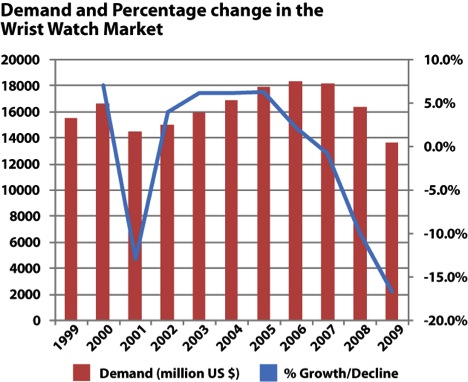
This chart begs but one question; tell me, Cassandra, which watch manufacturer believed you when you told them all that their biggest competitor of the new millennium would be the smart phone?
A company traversing No Man’s Land guards its prized product or service, refusing to believe that competitors have come up with something better, at its own risk.


