

 Doug Tatum’s best-selling business book No Man’s Land explores the misalignments that occur as companies attempt to traverse No Man’s Land, the place where middle market companies falter because they are too big to be small and too small to be big.
I want to explore a specific barrier to growth, what could be called a speed bump, that companies face in No Man’s Land. It is part of a company’s “Model”, which, along with Market, Management and Money, is one of the Four Ms or key issues that companies learning how to navigate through No Man’s Land must solve.
The particular case I want to focus on is the distribution system for a Texas-based entertainment lighting company that sells its products internationally.
This Texas-Based Company Successfully Demonstrates How to Navigate Through No Man's Land
The company’s distribution model worked fine in its earlier years when the company grew rapidly. It consisted of a two-step system for distribution in Europe. This replicated what had worked well for the company in the U.S.
The system consisted of selling to a major distributor in a prime location or, in the case of international sales, a prime country. The distributor then sold on to smaller countries. The company wasn’t particularly worried that the smaller countries were not always optimally served. The opportunity in those countries at that time was seen as small.
You can see in Figure 1 how the distribution model worked and the example of how the German distributor went on to service the company's Croatian customer or the UK distributor went on to service customers in the Scandinavian countries.
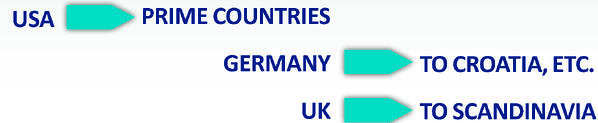 Figure 1
The company was glad to have distributor support not only for the prime European country but also for the smaller, surrounding countries. The model’s constraints began to emerge as the company looked for further growth from the outlying countries.
"Speed Bumps" in the Distribution Model
It incurred price resistance when the prime country’s distributors’ profit margin plus freight was added on to the final price. The product became substantially less attractive. Additionally these outlying companies needed assistance with purchase financing. The two-step distribution model prevented providing such assistance.
A new model was required because the value proposition and the value chain were out of sync. This need had to be addressed quickly to maintain the growth posture of the company.
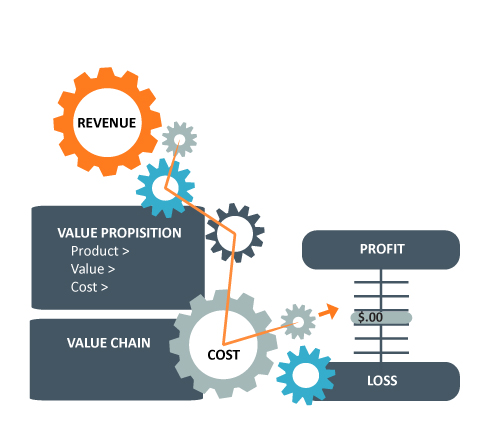 Figure 2
If the customers were able to obtain the product directly, the lower price for the product landed in their country could drive more sales to that customer.
Also, if the customer took product directly, the manufacturer could enable third party financing for the transaction. While the U.S.-based manufacturer would not be a party to the financing transaction, it could facilitate provisioning of the financing.
Stay Tuned for Part Two
This story will continue in the second part of this article series. Subscribe to our blog using the form to the right to receive an email notification when the article is published.

About the Author
Peter Duff is a versatile operating executive with a long record of accomplishments running a wide range of companies. As an EVP, COO and CFO, he has been responsible for significant improvements achieved in revenue, margins, expense and cash levels. Contact or learn more about Peter here. Connect with Peter on LinkedIn
Photo Credit: Flickr

