

 In our last article in this series, highlighting our firm’s Four Ms framework to get growing companies out of No Man’s Land, we focused on the “Model” issues confronting a growing electronics company in Austin. Today we move to the Market issues confronting a footwear company in northern New York State that I worked with closely. The company is 100 years old, making it anything but a start up. It is at the boundaries of middle market size, having become misaligned with its market. As a result, it is generating considerable losses. How did this once successful company become misaligned with the market place that it exists to serve?
The Original Success of Vertical Integration
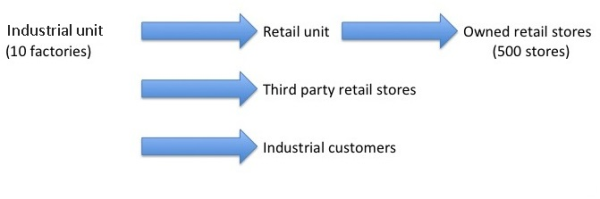
The company had vertically integrated, with 10 factories servicing 500 retail stores. In fact in the early days of the company their factories even cured the hides that went into the footwear.
This arrangement promised to produce the benefits of vertical integration: lower transaction costs than when third party suppliers and customers deal with each other, as well as tighter production coordination. Over time the company recognized some misalignment had crept in. With this realization, they moved to run the company as two separate business units under different heads: an industrial unit head and a retail unit head. The business then looked like this:
Figure 1.
Issues that Appeared
The problem that arose from this approach was that the head of retail was getting messages from the market place that the product produced in the domestic market place was poorly designed, had quality issues and compared with Asian imports was overpriced for the market place.
Interestingly, the head of the manufacturing unit was equally pained by the company’s strategy and structure. He was running numerous plants with mixed products and mixed quality standards. A blemish on a work boot with a steel top cap is much more acceptable than a blemish on a dress shoe. As manufacturing professionals will attest, it is a very difficult task to run a product through a plant with differing quality standards. In these situations, the quality tends to gravitate to the lowest common denominator.
In Figure 2, below, we see the new approach to the market place developed by the company to address the issues described above:
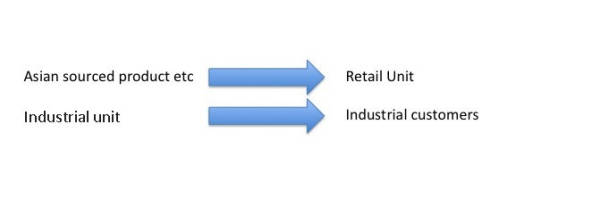
Alignment Achieved
Figure 3

The Industrial unit went on to high profitability and was eventually sold to a strategic buyer. The various brands thrive today in a new home. The retail group did re-align to the market place. But it found that there was considerable competition from other retail groups sourcing product from the same Asian factories and generating a lot of "me too" products in the stores. All those stores have now closed and the business unit no longer exists.
Lesson Learned
What do we take from this business case study of two misaligned businesses? In both cases, market realignment was absolutely key if money losing groups were to move toward profitability. This is a necessary (though not a sufficient) step toward profitability and a sustainable economic entity. Vertical alignment tends to work best in markets that are relatively static and predictable. It works less well in markets that feature a lot of innovation and competitive change. More next time when we take a look at another “M” of Newport’s Four Ms framework.
Did this post really resonate with you and your business? Do you feel like you may need guidance through No Man's Land? Learn to succeed by requesting your No Man's Land Diagnostic report from Newport Board Group. 

About the Author
Peter Duff is a versatile operating executive with a long record of accomplishments running a wide range of companies. As an EVP, COO and CFO, he has been responsible for significant improvements achieved in revenue, margins, expense and cash levels. Contact or learn more about Peter here. Connect with Peter on LinkedIn
