 Employee diversity is a subject that has recently inspired considerable debate—and some controversy. A prominent line of business thinking says that, for their own self-interest, companies should aspire to build a work force that reflects the demographics of their markets and customers.
We asked Newport partners what they see as to what extent employee diversity is a priority with their clients and other companies they know. Here are their responses.

Keith is a Newport partner in New England who has been president of operating divisions in four different Fortune 500 companies, in sales/marketing roles as well as other strategic leadership responsibilities.
“This appears to be an area of focus only among the largest, most visible companies, or among New Economy startups. The vast majority of businesses don't have this as a priority, or even something they think about, as far as I can tell.”

Ron is a Newport partner in West Florida who has a diverse background as a CEO and senior executive in the consumer packaged goods industry, especially food, with public and private companies.
“Not enough. Everyone talks about it, few actually embrace it, at least from small to medium sized businesses I have had contact with.”

Tom Henricks began his four decades in aerospace as a fighter test pilot in the U.S. Air Force before being selected by NASA to become an astronaut. After leaving NASA, Tom has held a series of senior level positions in the aviation industry.
“I see companies’ work force diversity matching the demographics of the work force in proximity to their business location-- rather than the demographics of their target markets.”

Sam, a Newport partner in Atlanta, is a seasoned executive with a record of implementing strategies to enhance revenues and profits across a variety of industries. He has particular expertise in assisting clients in redesigning their sales organization and sales management processes.
“Not at all. Especially with the size of the mid-market enterprises I'm working with. Not to down play it, but most have other priorities to worry about like revenue generation, profits, marketing, attracting the right person - regardless of gender, ethnicity etc.”

Art Medici has a diverse background as an executive leader in e-commerce, high tech, telecom and information companies. His experience spans startups, high growth small/mid cap firms and global leaders like Thomson Reuters.
“Even with diversity, execution is still essential to create high caliber offerings and excellent customer service. With a diversified work force, providing timely mentoring to employees becomes critical.”
.jpg?width=150&name=otto_billie-46_200x200_(2).jpg "Billie Otto")
Billie is a Newport partner in the Pacific Northwest who has been Executive VP and CIO of TrueBlue Inc. (NYSE: TBI) the largest industrial staffing firm in the U.S.
“It depends on the maturity of the company. A young company will have more employees who are friends and family talent as they seek to survive. They tend to be diverse/complementary in style. More mature companies with an established customer base or a desire to reach a new customer base approach diversity differently. In either case, good companies make it a point to seek input from a wide variety of sources, including a diverse work force, to combat a tendency to develop blind spots.”

Ted Parrish is a Newport partner in Dallas. His background in advisory services includes solving strategic and operating problems for banks, financial service companies, manufacturers, distributors, retailers and transportation companies.
“I do not believe that a lot of mid-sized business owners and CEOs spend a lot of time thinking about diversity unless they have regulatory pressure to do so. Diversity per se is not an obvious contributor to mid-market profitability or value (even though there are clear long term benefits). If diversity of their work force would present a company with an opportunity to access a particularly talented pool of resources for a specific purpose or application, interest is generally much higher.”
Do you know how to break through the second stage of growth?
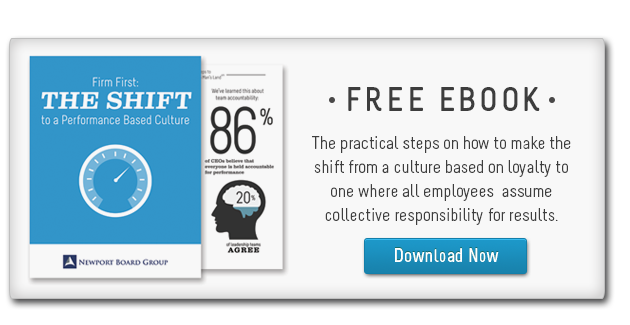
As CEO, it's your job to put the firm first and create a performance based culture. Download our free eBook to get the pratical steps that will help you make the shift to this type of business culture.