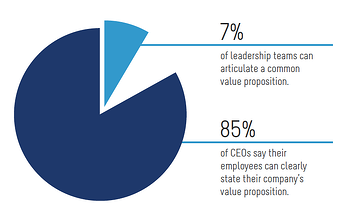
 Most CEOs are unaware of a festering problem that plagues the majority of emerging growth companies. It’s a malady that can go undetected and be damaging to an organization, affecting customer experience while hindering communication and execution at the most critical stage of corporate growth.
Growing companies without a cohesive value proposition have difficulty creating the right economic model that profitably fulfills their brand promise. They’re either in No Man’s Land℠, the stage when growing companies fail, or they’re heading there at a fast and reckless rate of speed.
"It’s a problem that pervades Silicon Valley. Sometimes people think that a simple description of a product means there isn’t much there. But really it’s the opposite. You have to be able to distill down what you do in a way that your customers can easily understand the value proposition. It’s hard, but it’s also a business necessity."
- Michael Arrington, Tech Crunch
We’ve seen hundreds of growing companies in the past few years stall in their growth when the CEO and leadership team get foggy on the value proposition. Lack of clarity and alignment around the company’s “unique competitive advantage”, as well as other critical second-stage growth symptoms are common to companies that are too big to be small and too small to be big. Companies enter No Man’s Land℠ as they grow past startup and enter adolescence. The disturbing fact is that over 90% fail to survive No Man’s Land and achieve scale. It’s a period of strategic confusion and inadequate resources, as Doug Tatum describes:
 “No matter how good their core business concepts, the companies I’ve seen have been pushed by growth into an uncomfortable situation where the resources and approaches that had allowed the firm to grow in the first place suddenly became insufficient and even an obstacle to further growth. Customers went away dissatisfied, and the entrepreneur in question felt disoriented, as if he or she were gradually and inexplicably losing control.”
*Doug Tatum’s book, No Man’s Land, was recognized in the 2011 book, The 100 Best Books of All Time by Jack Covert and Tom Sattersten.
No Man’s Land market issues center around the relationship between company and client. Growing companies that enter No Man’s Land not only struggle with their value proposition, they also often find it difficult to identify their most profitable clients or the cost of acquiring a profitable customer. They also have a tendency to make promises to customers that they are only 70% able to keep.
No Man’s Land is a stage of confusion and distraction. After months, perhaps years of solid growth the company realizes they’re not quite sure why they’re in business. The value proposition become ambiguous at best and the economic model, or lack thereof, does not enable the company to make money at higher volumes. One of the reasons No Man’s Land claims so many victims is the loss of the CEO/Founder’s tenacious focus. What does the CEO often do? He or she gets bored with the operations of the business and starts innovating in a different direction.
Instead of a new idea, the leadership team should realign on the value proposition and refresh the economic model. This refocus increases the probability that the company will survive No Man’s Land and thrive in more profitable revenue zones.
I’ll describe the ripple effects throughout your company of a foggy Value Proposition in my next post.

About the Author
Brent Sapp is CEO and Co-Founder of Inc. Navigator, as well as the Founder of the Economy Heroes movement (@EconomyHeroes). Inc. Navigator serves as Newport's strategic technology provider. You can contact Brent by email at brent@incnav.com or learn more about him here. Connect with Brent on LinkedIn